The Knowledge Gap Between Homeowners and Irrigation Specialists Is Worth 390 Billion Gallons a Year
By Steve Whitesell, Executive Editor
Smart irrigation can save the average household with in-ground irrigation up to 15,000 gallons annually, when a certified specialist calibrates it to the property’s soil, climate, and plant types.
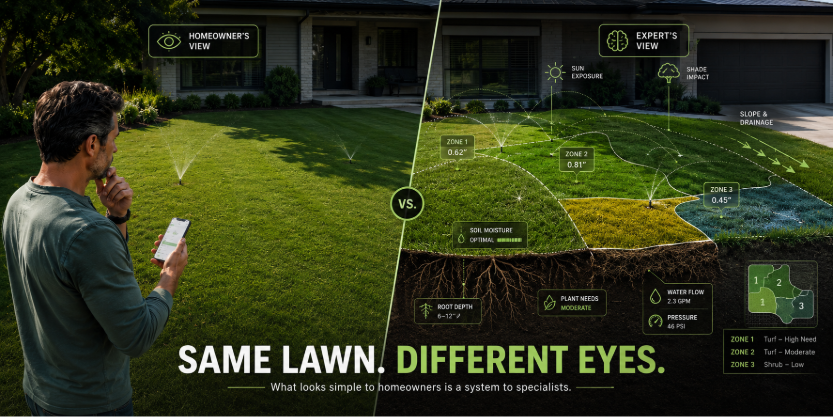
When I upgraded my smart irrigation controller last year, I set it up myself. That meant making decisions based on criteria that most homeowners would not know how to judge in order to determine watering frequency and timing by zones.
Key Takeaways
- Professional calibration nearly doubles smart irrigation savings: from 8–22% out of the box to 36–46% when a specialist tunes it.
- The barrier is knowledge, not tech: calibration requires expertise most homeowners can’t DIY, making smart irrigation a top candidate for pro installation.
- Awareness is the missing piece: most homeowners don’t even know certified irrigation specialists exist.
Criteria include soil type, evapotranspiration values, plant water use coefficients, and precipitation rate, not to mention the impacts of slope and exposure. These factors all play a crucial role in developing an appropriate irrigation schedule.
Smart irrigation systems improve efficiency by better matching water use to what the landscape actually needs, based on assumptions about seasonality, soil type, and plant water requirements. Research shows they can improve water efficiency right out of the box, like the 8% improvement measured in a University of Florida study in certain soils. However, a water efficiency plan developed by an irrigation specialist boosted savings to 36% by calibrating the system for the property’s unique conditions — and educating homeowners on the technology.
Uncommon Knowledge for Homeowners is Second-Nature for Experts
These calibrations require a DIY homeowner to learn complicated topics such as identifying soil composition and water-holding capacity, the plant-soil-water relationship, hydrozone planning, distribution uniformity, catch-can testing, and evapotranspiration calculations. However, these are standard practices for an irrigation specialist who completes one of seven training programs certified by the U.S. Environmental Protection Agency’s WaterSense program. The QWEL training program, for instance, requires 20 hours of instruction across ten subject areas.
New survey data from consumer technology market research firm Parks Associates shows that smart irrigation systems rank as the second-most-difficult smart home product category for self-installation. (It trails only smart water shut-off valves.) In its 2026 whitepaper, “Flooding the Market,” Parks researchers report that smart sprinklers are, consequently, “among the top smart home devices to be professionally installed.”
“Instead of just temperature and then comfort, which is your metric for a smart thermostat, here you have climate, plant type, and soils — which are all much more heterogeneous from installation to installation,” says Andrew D. Morris, director of policy and technical affairs at the Irrigation Association. The membership organization represents manufacturers, dealers, distributors, installers, and other professionals. It also operates a WaterSense-certified training program for irrigation specialists.
WaterSense also has certification standards for smart sprinkler systems based on the Irrigation Association’s Smart Water Application Technologies (SWAT) testing protocols, conducted by independent labs. In official documents, EPA recommends that “purchasers of these products use the services of irrigation professionals who have been certified through a WaterSense labeled program,” which are listed in its national online directory.
How Uncommon Knowledge Nearly Doubles Water Efficiency
In 2009, Orange County Utilities in Florida wanted to quantify the efficiency potential of smart irrigation as part of a larger program to manage strained water resources. It commissioned the University of Florida to conduct a long-term study, which monitored 167 households. Two types of smart controllers were evaluated: soil moisture sensor-based (SMS) systems and evapotranspiration (ET) systems (which typically rely on weather data to calibrate watering needs). Each type was tested in two groups. One used default contractor settings. The other included a follow-up visit in which a specialist implemented an irrigation efficiency plan tuned to factors such as the property’s specific zone application rates, root depths, and microclimate. They also educated the homeowner on the benefits of the technology and how to monitor its performance. A fifth group without smart sprinklers was monitored as a baseline. Turf quality was unaffected across all scenarios.
The extra attention always improved water savings to some degree. Homes that received ET controllers — the technology used in major consumer brands such as Rachio, Hunter, and B-Hyve — saw 21% water savings with default settings and 30% with professional follow-up on the region’s flatwoods soil. The figures were 8% vs. 36% on sandy soils.
SMS systems posted savings of 22% with default settings on flatwoods soil, jumping to 46% with professional follow-up — the best result of any treatment in the study. On sandy soils, SMS alone saved 32%, while SMS with professional follow-up saved 36%. Researchers believe that the minimal additional gain from professional follow-up on sandy soils was due to burying the sensors at 3 inches depth, vs. the default 6 inches, triggering more frequent irrigation as fast-draining sandy soil.
The potential benefits of widespread water efficiency plans are tremendous. EPA estimates that roughly 28.8 million residential in-ground irrigation systems are installed across the country, although the portion that has smart controllers is unclear. (The most recent estimate, from 2014, put it as less than 10 percent.) EPA estimates that proper smart-controller adoption and calibration nationwide could save more than 390 billion gallons annually. At an individual level: Households could conserve over 15,000 gallons of water each year.
Six Things Homeowners Never Ask Specialists About, But Should
A certified specialist’s work goes beyond an out-of-the-box installation or DIY adjustments by homeowners. A custom irrigation efficiency plan is a structured audit, measurement, and calibration process.
They begin by evaluating a property’s specific conditions, including soil type and water-holding capacity, plant types and their water needs (hydrozones), microclimate, slope, and sun exposure.
The specialist then performs six field measurements:
- Distribution uniformity testing to determine whether sprinklers water evenly within each zone. They typically use the catch-can test: placing measuring containers across a zone and running the system to determine how much water lands at each point.
- Pressure check to verify that system pressure matches what the sprinkler heads are designed for, preventing inefficiencies that result from over-pressurized systems.
- Leak and component checks identify broken or tilted heads, underground leaks, and clogged nozzles (all common problems).
- Precipitation rate measurement per zone uses catch-cans to measure the depth of water that falls per hour, in order to set how long the sprinkler should run for adequate watering.
- Evapotranspiration-based scheduling determines the plants’ exact water needs, based on an assessment of local climate and weather data.
- Root depth and soil calibrations are used to adjust runtime so water reaches the root zone and isn’t lost to runoff before reaching the roots or deep percolation past them.
With all this information in hand, the irrigation specialist programs the controller to implement that water efficiency plan, maximizing performance in this setting. The efficiency plan is not complete until the handoff to the homeowner, explaining what was done, what the homeowner should monitor, and how to perform seasonal assessments to determine if the system needs adjustment. The University of Florida study in Orange County credited this step with ensuring the best long-term results.
Making Uncommon Knowledge Common with Education
Education must start long before an irrigation specialist completes their job. Many homeowners do not know that such professionals exist, nor how an irrigation efficiency plan can conserve water far more than default settings or DIY adjustments — without affecting the quality of their lawn. Only when they understand the benefits of these services can homeowners make the right decision.
Image: Produced with artificial intelligence.