Water Utility Campaign Drove 600% Homeowner Demand for Expert Help
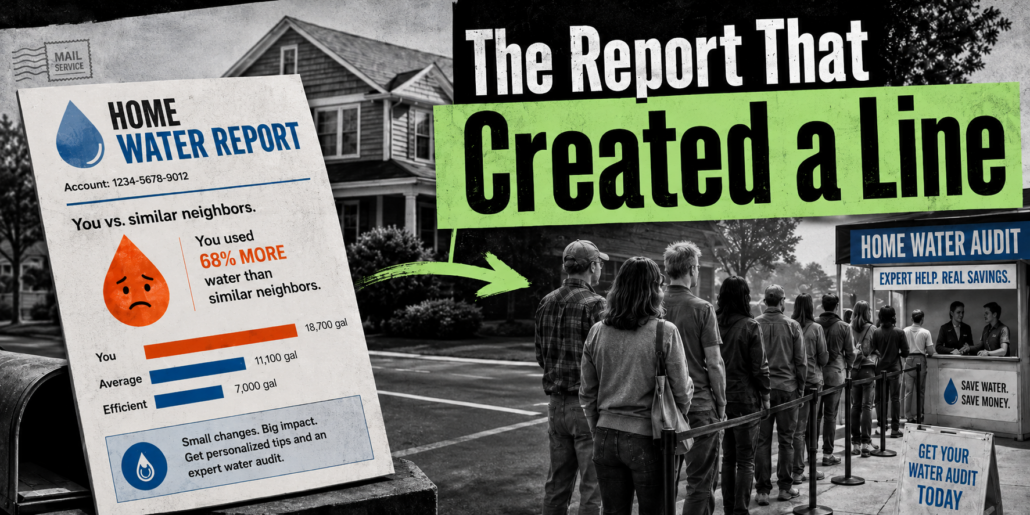
Custom reports comparing households to their neighbors motivated a sixfold rise in home-audit requests and more than doubled enrollment in conservation programs.
In 2012, the East Bay Municipal Utility District (EBMUD) in northern California faced a challenge that is increasingly common for water districts around the U.S.—drought and mandates.EBMUD was already operating under a state mandate to cut per-capita water use 20 percent by 2020, and its reservoirs were beginning a multi-year decline due to what would become California’s worst drought on record. The upside was that its 1.4 million customers in Alameda and Contra Costa counties were generally conservation-minded. The downside was that the district had largely exhausted easy wins, such as promoting low-flow fixtures, offering rebate programs, and introducing tiered pricing.
What they hadn’t tried was simply telling people how they compared to their neighbors.
Key Takeaways: How a Mailed Report Motivated Change
- Neighbors comparison drives motivation. Seeing how their water use compared to neighbors’ encouraged homeowners to improve their efficiency.
- Informed consumers seek assistance. The reports prompted a more than sixfold increase in requests for home water audits, showing how comparative information can drive demand for expert help.
- Change needn’t be expensive. Annual cost per household ran between $4.50 and $6.60.
How the Program Worked on the Ground
The program combined tailored information with proven research in behavioral science.
Relevant context and concrete suggestions
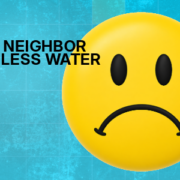
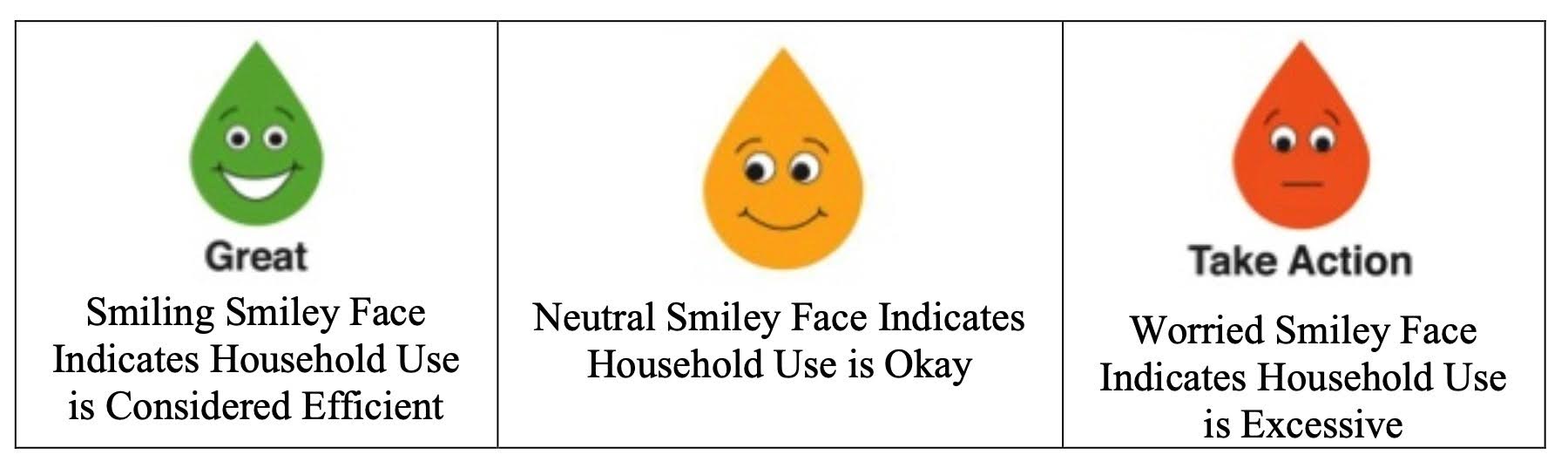
EBMUD partnered with WaterSmart Software, a San Francisco startup (WaterSmart was acquired by VertexOne in 2020.) that created Home Water Reports. The utility mailed each household a personalized comparison against similar nearby homes, complete with a numerical performance score and an emoticon summing up how well they were doing: green, smiling; yellow, neutral; red/orange, worried. The report also provided a set of tailored conservation tips.
Starting in June 2012, about 10,000 EBMUD residential customers began receiving the reports every two months — mailed separately from their bills. A randomized control group received no reports, enabling an independent evaluation of the program’s effectiveness. The pilot ran for one year, jointly funded by EBMUD, WaterSmart Software, and the California Water Foundation.
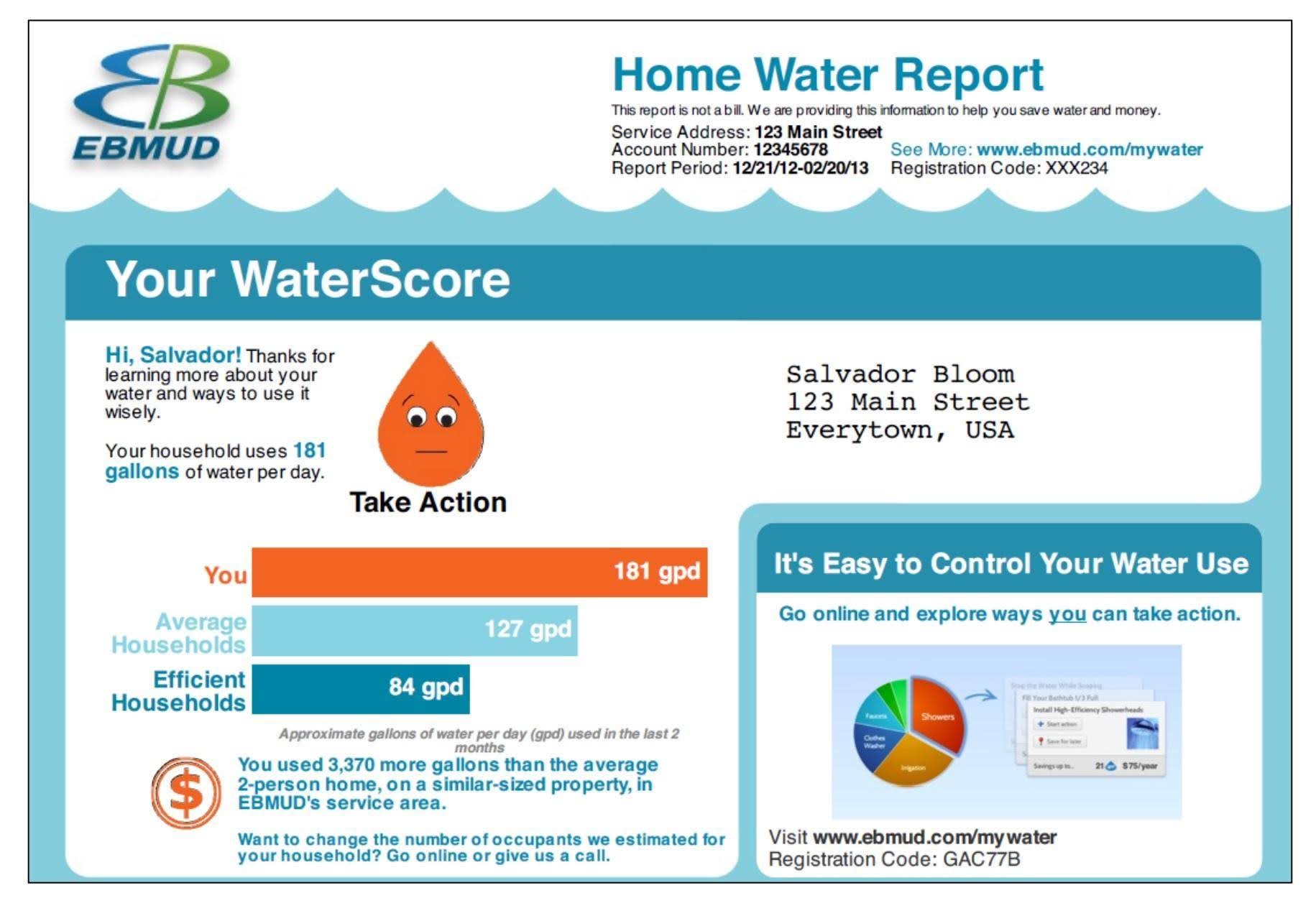
Action motivated by comparison
This strategy draws on decades of research — most notably by psychologist Robert Cialdini, who demonstrated that people are often prompted to change their behaviors more by observing the actions of those around them than by responding to financial incentives or moral arguments. Energy companies had been taking this approach to conservation for years, using a program by a company called Opower (now part of Oracle). EBMUD and WaterSmart were now trying the same strategy to improve home water efficiency.
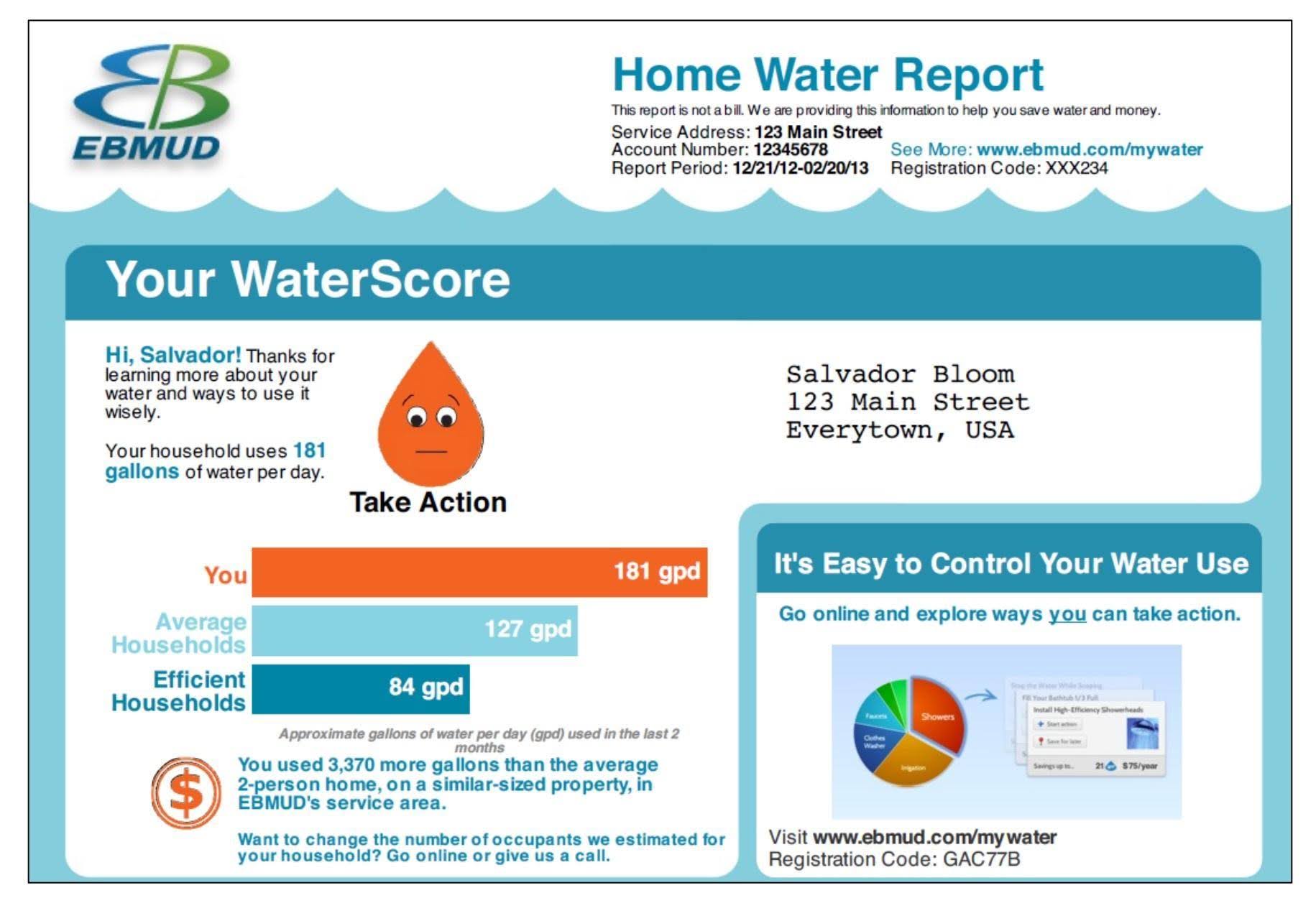
What Changed as a Result of the Pilot
- The immediate benefit was a 5% reduction in residential water use vs. control. This exceeded the pilot’s target of roughly 2%.
Participants were 6.2 times more likely to request a home water audit. - Participating households were 2.34x as likely to enroll in other EBMUD conservation programs (audits, rebates, and similar programs).
EBMUD subsequently expanded the program system-wide as part of a broader conservation strategy. - That overall strategy reduced per-capita water use by 26% by 2020 — exceeding the state’s 20% mandate.
Why the Audit Interest Matters Most
A 5% cut is good. A 6X increase in audit requests is structural. Instead of just a one-shot campaign, EBMUD built a pipeline for further engagement with other programs. Once a household sees itself as the “kind of household that conserves,” requesting an audit becomes a way of acting on that identity.
How To Do the Same
Use apples-to-apples comparisons. A town, county, or ZIP code encompasses a wide variety of properties. Narrow comparisons to homes of similar lot size, irrigated area, and household size.
Use peer pressure for good. Show customers how they stack up to peers, and they will take initiative on their own.
Use obvious action prompts. Now that they want to change, give them easy, tailored steps they can follow.
Offer assistance. Encourage customers to go further with free, tailored audits and education programs.
Send it separately from the bill. Provide a single, focused message in the mail (or online account update). Extra info added to an already-packed bill will get lost or ignored.
Why this matters for policy and capital planning: Behavioral programs as a complement to supply-side investment. Cheaper than building, and increasingly relevant as the West moves into chronic-drought conditions.
How can other conservation programs use this
See how homeowners could save 15,000 gallons per household if they used certified experts.
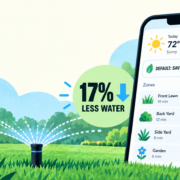
Background: Research shows that the smart irrigation systems that many utilities already provide or subsidize achieve much higher efficiencies when calibrated by a professional (something the U.S. Environmental Protection Agency recommends).
Why this works: Default settings on these devices are generalized, but custom-programming requires expertise and equipment that DIY homeowners don’t have.
Remember This: EBMUD didn’t get people to use less water by lecturing them. It gave them comparative information, insight, and direction to motivate change. Five percent water savings for today, greater interest in further education and action for the future.
The Numbers
10,000 — Residential households in the pilot (Alameda & Contra Costa Counties, CA)
June 2012 – June 2013 — Pilot duration
5% — Reduction in water use vs. control
6.2× — Participating households’ likelihood of requesting a home water audit
2.34x — Treated households’ likelihood of enrolling in other EBMUD conservation programs
~66% — Share of savings from behavior change (esp. outdoor watering)
~33% — Share of savings from fixture retrofits
26% reduction by 2020 (as a component of a larger strategy)
$4.50–$6.60 — projected annual cost per household at scale
Sources
Evaluation of the East Bay Municipal Utility District’s Pilot of WaterSmart Home Water Reports. Prepared for California Water Foundation and EBMUD (Mitchell, D.L.; Chesnutt, T.W. 2013)
Social Comparisons, Household Water Use, and Participation in Utility Conservation Programs: Evidence from Three Randomized Trials (Brent, D.A., Cook, J.H., & Olsen, S. 2015).
Social Norms Messaging: How Water Agencies Can Change Our Habits (Water Deeply, 2016)
New technology reduces home water use by 5 percent (East Bay Municipal Utility District 2014)
WaterSmart: Changing Consumer Behavior (Water Foundation)
EBMUD Urban Water Management Plan 2020 (EBMUD, 2021)
Crafting Normative Messages to Protect the Environment (Cialdini, R.B. 2003)
Want to Save Water? Try Some Neighborly Competition (KQED, 2014, updated 2024)