Why Affluent Neighborhoods Use Outdoor Water Inefficiently
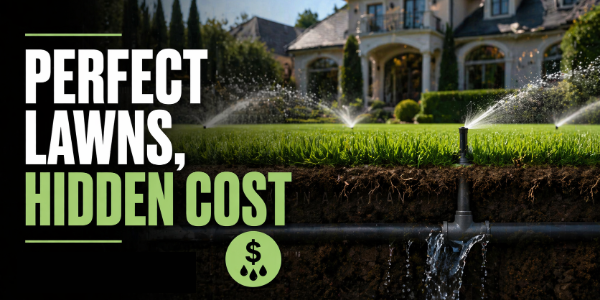
Affluent neighborhoods and HOA-managed properties should be conservation success stories. They have the resources for efficient systems, professional management, and regular maintenance. Instead, they’re often the most inefficient.
The problem isn’t lack of money: it’s misaligned incentives. Homeowners who don’t check bills have no feedback on efficiency. HOA contractors get paid to keep landscapes green, not to save water. Systems run on autopilot while no one monitors consumption.
Key Takeaways:
- Affluent homeowners don’t check bills
- HOA contractors prioritize aesthetics over savings
- No one monitors actual consumption
- Oversight gaps create massive waste
We spoke with water conservation experts to understand why wealth and professional management often increase—rather than decrease—irrigation efficiency.
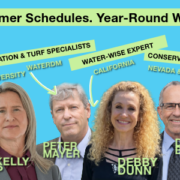
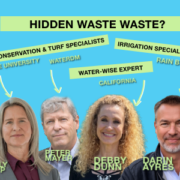
Bill McDonnell, Water Efficiency Manager
Bill McDonnell is a veteran water conservation manager from the Metropolitan Water District of Southern California and is a contributor to the Healthy Green Spaces Coalition. His career spans five decades in water and energy efficiency design, and he currently sits on the boards of the Alliance for Water Efficiency and the California Irrigation Institute.
McDonnell identifies the wealth paradox:
“In affluent neighborhoods, many homeowners don’t know their bills, and over-irrigation can be an issue.”
“Many contractors have no incentive to save water—only to ‘keep everything green.'”
McDonnell’s takeaway: Affluent homeowners often autopay bills without checking consumption. Water bills that would alarm middle-income families go unnoticed, eliminating the price signal that normally curbs inefficiency. Meanwhile, HOA contractors face a different incentive structure entirely. They’re hired to maintain aesthetics, not conserve water. Overwatering is safer than underwatering—brown spots get noticed, inefficiency doesn’t. As research shows, irrigation system management drives water savings, but HOA contractors rarely prioritize efficiency over appearance.
Debby Dunn, Waterwise Landscape Expert
Debby Dunn brings decades of experience in water conservation program design and implementation, specializing in waterwise landscaping and efficient irrigation. Her experience includes assisting and educating over 12,000 people over the decades including her positions as the Water Conservation Administrator of the City of Beverly Hills and the Senior Water Resource Specialist for the San Diego County Water Authority.
Dunn witnesses the disconnect firsthand:
“With Advanced Metering Infrastructure on the City’s water meter, I could see the data showing a resident’s irrigation running every day at 2 a.m.—but the customer had no idea.”
Dunn’s takeaway: Irrigation systems often run on autopilot with no one monitoring actual water use. Property owners rarely check if their systems are functioning correctly. Landscapers and gardeners maintain schedules but don’t optimize them. Without monitoring—either through flow meters or simple observation—inefficiency continues indefinitely.
Jenna Battson, Turf Replacement Grant Program Manager, Colorado Water Conservation Board
Jenna Battson, Lead Drought and Conservation Analyst for the Colorado Water Conservation Board, promotes realistic, feasible, data-driven strategies for water efficiency and conservation. Her work emphasizes bridging research and implementation through stakeholder engagement, technical assistance, and resource development to help reduce statewide water use.
Battson is widely recognized for fostering collaboration among water providers and industry professionals to advance innovative conservation practices that address the growing pressures on Colorado’s water resources. Previously CWCB’s Outdoor Water Conservation Coordinator, she manages the state’s Turf Replacement Grant Program and leads statewide municipal water-use studies, including the 2025 Transformative Landscape Change State-of-the-Science Report.
Battson points to a structural problem inside HOA communities that price signals simply can’t reach:
“Monthly water bills, a primary and valuable communication tool for usage and pricing information, can be less effective in HOAs without individual unit meters. Aggregated billing can conceal individual consumption, and the bill’s visibility is often limited to the payer. This means price signals may not reach the actual end users, making water bills less effective at promoting behavioral change.”
The result can be a community-wide disconnect between consumption and cost:
“Water users can be unaware of their inefficient or excessive consumption because their bills, which they may or may not see, reflect the collective community use rather than the price impact of individual behaviors. The situation is comparable to receiving a class grade instead of an individual assessment. A class grade of a B+ might appear excellent, even if your personal efforts warrant a D. Without recognizing your individual impact, you can’t make corrections.”
Battson’s takeaway: When water costs are pooled and invisible to individual water users, conservation can lose its economic anchor, making informational billing less effective at motivating behavioral change. Where separate-unit metering or direct billing that consistently reaches the end user is not feasible, other behavioral-change tactics, such as water budgets, actionable water audits, excessive-use charges, educational messaging, and incentive programs, can help improve conservation and efficiency. The reality is that there is rarely a one-size-fits-all solution to any problem, so multifaceted approaches can increase the likelihood of meaningful behavioral change.