Finding Invisible Waste – Expert Insights on Leaks and Loss: Water Waste Roundup
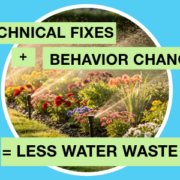
A single broken sprinkler wastes more than 25,000 gallons per year. One pop-up head missing its top? Over 23,000 gallons annually.
Research confirms the scale: 30-60% of irrigation water is wasted due to leaks, broken heads, and poor maintenance. While you’re investing in smart controller rebates and drought-tolerant plant education, broken irrigation components are quietly hemorrhaging water across your service area.
Key Takeaways:
- A single broken sprinkler head can waste 25,000+ gallons per year
- Underground leaks are invisible to property owners, especially when systems run at night
- Residential irrigation systems rarely include flow meters that could detect leaks immediately
- Detection gaps mean leaks continue for months before anyone notices
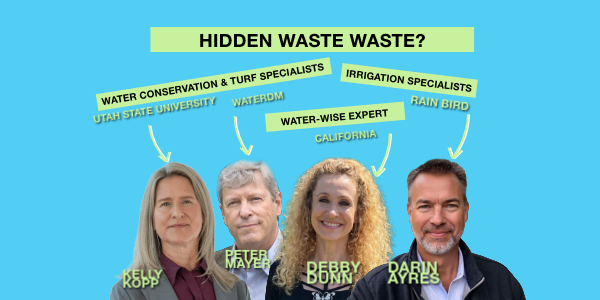
Dr. Kelly Kopp, Professor and Water Conservation and Turfgrass Specialist, Utah State University
Dr. Kelly Kopp is a Professor and Extension Water Conservation Specialist at Utah State University and Director of the Center for Water Efficient Landscaping.
A nationally recognized expert in urban water conservation, turfgrass science, and homeowner irrigation behavior, she leads Utah State University’s Water Check Program, which has helped thousands of residents and businesses reduce outdoor water use through in-yard irrigation audits, behavioral and technical guidance
Dr. Kopp’s conclusion is stark:
“A single broken sprinkler head can waste more than 25,000 gallons of water a year.”
Kelly Kopp’s takeaway: Multiply that across properties with two, three, or five broken heads, and the numbers become staggering quickly. Her research shows that irrigation system improvements drive the majority of water savings in landscape conservation programs. Yet leak detection remains an afterthought in most residential conservation strategies.
Debby Dunn, Water-wise Landscape Expert
Debby Dunn brings decades of experience in water conservation program design and implementation, specializing in waterwise landscaping and efficient irrigation. Her experience includes assisting and educating over 12,000 people over the decades including her positions as the Water Conservation Administrator of the City of Beverly Hills and the Senior Water Resource Specialist for the San Diego County Water Authority.
Dunn knows the exact math—and the detection problem:
“One pop-up sprinkler missing its head is wasting 15 gallons a minute… that’s over 23,000 gallons a year!”
“If you run your irrigation during sleeping hours, you may never know the nightmare issues occurring in your system – both leaks and runoff!”
Dunn’s takeaways: Most residential customers run their systems at night, creating a blind spot for leaks and water waste. Property owners don’t realize the problem until brown patches or high water bills appear, typically months after the waste began. Commercial landscapers also run the irrigation at night and may not know about a major issue for even longer. This is due to reduced observation from the tenants, the maintenance team, and an auto-paid bill.
Peter Mayer, Principal and Founder of Water Demand Management
Peter Mayer, Principal and Founder of Water Demand Management Peter Mayer is Principal and Founder of Water Demand Management, a Professional Engineer and urban water demand expert whose work focuses on water demand research and efficiency planning. In 2025, he received the Water Star award from the Alliance for Water Efficiency and has worked with hundreds of water utilities throughout the US and Canada.
Mayer identifies the worst offenders:
“Leaks happen in a variety of situations, from silent toilet flappers to dripping bathtub spouts, to leaking irrigation valves, and even underground leaks from pipes and service lines. Leaks happen at pretty much every household at some point in time.”
Mayer’s takeaway: Above-ground problems eventually become visible. Underground leaks just keep running—for months, sometimes years—hemorrhaging water 24/7 while property owners remain unaware until catastrophic failure or massive water bills force action.
Darin Ayres, National Sales Manager for Specification at Rain Bird Corporation
Darin Ayres is the National Sales Manager for Specification at Rain Bird Corporation, where he works with water agencies, municipalities, and universities to create sustainable, water-efficient landscapes.
Ayres sees the solution—and the gap:
“A simple flow meter lets you detect leaks the moment they happen.”
“Residential systems almost never include flow meters—and that’s where massive unseen waste occurs.”
Ayres’ takeaway: Flow meters can identify leaks immediately—broken heads, stuck valves, underground leaks. Commercial properties have them. Individual homeowners? Almost never. The properties with the least oversight are where the most waste occurs.
Your Conservation Program’s Next Move
The technical solution is straightforward: flow meters, regular irrigation audits, and system maintenance. The challenge? Homeowners avoid conservation programs when upfront costs, complexity, or perceived risk feel high.
Three immediate actions:
- Subsidize flow meter installations to overcome upfront cost barriers
- Make leak detection visible through yard signs and neighborhood dashboards
- Simplify audit processes with pre-approved contractor lists and instant rebates
For a comprehensive behavioral playbook, see our guide on 34 tactics that increase conservation program participation.