Distribution Uniformity Is the Hidden Driver of Overwatering: Water Waste Roundup

You can provide education and rebates all day long. But if irrigation systems can’t distribute water evenly, you’re subsidizing waste.
A University of Florida study found that most residential systems score between 40-60% Distribution Uniformity (DU); at 50% DU, the wettest areas get twice as much water as the driest spots.
Key Takeaways
- Poor distribution uniformity (DU) is one of the biggest sources of turf water waste
- Most residential and commercial systems run at 40-60% DU, meaning wettest areas can get twice as much water as driest spots
- Plant choice and smart controllers can’t overcome poor distribution uniformity
- The wrong water pressure and small physical obstructions create massive coverage gaps
- Property managers and landscape contractors often water long enough to save dry spots, overwatering everything else in the process
We spoke with water conservation managers and irrigation industry experts to understand why distribution uniformity matters and what’s causing the problem.
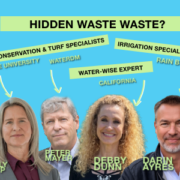
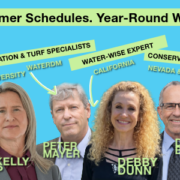
Bill McDonnell, Water Efficiency Manager (Retired), Metropolitan Water District of Los Angeles
Bill McDonnell is a retired Water Conservation Manager from the Metropolitan Water District of Southern California and an active contributor to the Healthy Green Spaces Coalition, advancing awareness and action around water waste and sustainable outdoor water use.
McDonnell’s career spans 5 decades in the field of water and energy efficiency. He currently sits on the boards of the Alliance for Water Efficiency and the California Irrigation Institute.
Bill had 3 key points about DU:
“Distribution uniformity is a huge issue with turf water waste.”
“It doesn’t matter what you put down: if you water it incorrectly, you’re over-watering it.”
“Even if you put in new seedling, water-efficient turf, if you still have the same DU… you’re gonna have all that waste.”
McDonnell’s takeaway: Plant choice can’t overcome poor irrigation design; fix the system first. Conservation programs that focus solely on drought-tolerant landscaping or smart controllers without addressing distribution uniformity are missing a huge opportunity for water savings.
Doug Bennett, Conservation Manager, Washington County Water Conservancy District
Doug Bennett is a contributor to the Health Green Spaces Coalition, is the Conservation Manager for Utah’s Washington County Water Conservancy District, and has 30 years of water-conservation experience across three western water agencies. Prior to joining Washington County, Doug spent over 2 decades with the Southern Nevada Water Authority (SNWA), where he helped design and implement some of the nation’s most influential outdoor water-efficiency programs.
Doug is widely recognized for his leadership in conservation program design, incentive structures, and public engagement, and he continues to play an active role in national water-efficiency organizations, conferences, and advisory efforts. He has received more than a dozen professional honors recognizing his lasting impact on water conservation policy and practice.
Bennett highlights how easily irrigation coverage breaks down:
“An obstruction the width of a blade of grass close to the spray head can create up to an 8-foot gap in coverage”
Bennett’s takeaway: Small obstructions can create massive coverage gaps, undermining even well-designed systems. Regular inspections to identify and clear obstructions, adjust heads, and verify coverage patterns should be a priority in any program focused on reducing irrigation waste.
Darin Ayres, National Sales Manager, Rain Bird Corporation
Darin Ayres is the National Sales Manager for Specification at Rain Bird Corporation, where he works with water agencies, municipalities, and universities to create sustainable, water-efficient landscapes.
Ayres points to pressure problems as a major culprit:
“Most systems are either under- or over-pressured, so you get really poor distribution rates.”
“People water to their ‘minimum dry spot,’ which means everything else is overwatered.”
Ayres’ takeaway: Wrong water pressure creates uneven coverage, forcing property managers to overwater everything to save the driest areas. Addressing pressure problems and distribution uniformity targets the root cause of overwatering, delivering more savings than behavioral change campaigns alone.
Next Steps
So how do you get residents to actually test and fix their systems?
Technical rebates for irrigation audits or system upgrades often fail because homeowners don’t know they exist, don’t understand the value, or find the process too complex. Even when residents are motivated, high upfront costs and complicated applications create barriers that kill participation.
The solution is behavioral design. Making conservation visible, social, and simple multiplies participation without increasing rebate amounts.
Start here: Read our guide on 34 behavioral tactics that increase water conservation program participation. You’ll learn specific strategies to:
- Make DU improvements visible through yard signs and neighborhood dashboards
- Use social proof to normalize irrigation system maintenance
- Simplify rebate applications with instant rebates and pre-approved contractor lists
- Lower barriers that prevent motivated homeowners from taking action