34 Behavioral Tactics Utilities Can Use to Increase Residential Water Conservation
Executive Editor: Steve Whitesell
Author: Kevin Rowe
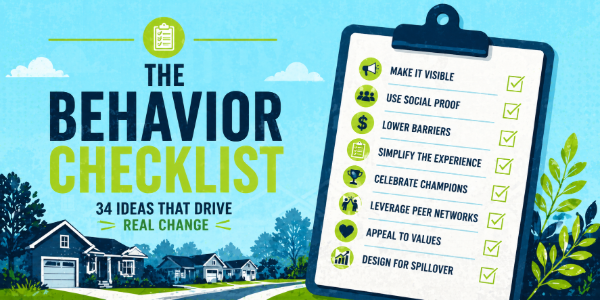
This is a behavioral playbook — a practical, research-based guide to help water conservation managers design rebate programs that people actually use.
Behavioral Science Field Ready Tactics
- Visible → Neighbors can see it.
- Social → People feel part of a local movement.
- Simple → Fewer forms, faster results.
- Rewarding → Emotional pride, not just financial payback.
Instead of focusing only on financial incentives, this list integrates insights from four behavioral science studies:
- Upfront Costs Shape Conservation (loss aversion, complexity barriers)
- Norm Nudges Drive Long-Term Conservation (social comparison and peer pressure)
- Spillover Adoption (visibility and viral diffusion)
- Motivations for Landscape Change (emotional and identity drivers)
Why is this Important?
For water conservation managers working with limited budgets, this behavioral checklist is essential because it helps every rebate dollar go further.
By designing programs that make conservation visible, social, and simple, managers can turn one rebate into a ripple effect of voluntary action across neighborhoods—driving adoption without raising incentive costs.
Instead of relying solely on bigger rebates, they can leverage behavioral cues like yard signs, dashboards, and peer comparisons to multiply participation, stretch funding, and achieve larger, longer-lasting water savings.
Here’s your list.
 Want a framework for turning behavioral research into utility programs? Read how community-based social marketing helps conservation teams remove barriers and make water-saving behaviors easier to adopt.
Article: Community-Based Social Marketing: Increase Water Conservation with Limited Rebate Budgets
Make Conservation Visible
People copy what they can see — visible proof triggers neighborhood imitation.
Tactics
- Yard signs or lawn stakes: “This yard saves 30% more water — scan to see how.”
- Public dashboards: Map water-use rebate participation by block or ZIP.
- Neighborhood “leaderboards”: Show top-performing areas in newsletters or city sites.
- Open-house tours: Partner with HOAs or garden clubs to feature upgraded yards.
- Street banners or local media spotlights on “Water-Smart Neighborhoods.”
Why it works: Visibility transforms private upgrades into public signals of social status and pride.
Use Social Proof and Norm Nudges
Show that most people like you are already conserving — or that you’re falling behind.
Tactics
- “Neighbors like you” mailers comparing household use vs. neighborhood median
- Utility-sent feedback letters: “You used 20% more than similar homes last month.”
- Digital dashboards showing household rank among local peers.
- Social-media shoutouts and badges (“Top Saver on Your Street”).
- Community competitions: reward neighborhoods that hit collective savings targets.
Why it works: Norm-based messages cut water use by 5% on average and increase participation in other programs (“crowding-in” effect).
Lower Upfront Barriers
High initial costs and complexity feel like losses — delay kills motivation
Tactics
- Offer instant or point-of-sale rebates instead of delayed reimbursements.
- Reframe messaging: “Earn $3 per sq. ft.” instead of “Get reimbursed.”
- Offer rebates that include installation services costs or referrals to reduce friction.
Why it works: Smaller, faster rewards outperform large, delayed rebates; instant feedback overcomes loss aversion.
Simplify the Experience
Even willing homeowners quit when the process feels complex or uncertain.
Tactics
- Auto-fill addresses, lot sizes, and account numbers in forms.
- Provide pre-approved contractor lists and neighborhood installers.
- Create one-click scheduling for inspections or site visits.
- Provide clear “before/after” visuals and sample designs.
- Bundle rebates with design templates for common yard types.
Why it works: Reducing cognitive load doubles participation among busy households.
Celebrate and Publicize Local Champions
Turn adopters into advocates who amplify the message.
Tactics
- Photo features of local families who “made the switch.”
- “Water-Wise Champion” yard plaques or neighborhood awards.
- Short testimonial videos shared on city or utility social media.
- Host local “thank-you” events for rebate participants.
Why it works: Public recognition builds pride and social contagion — every upgraded lawn becomes marketing.
Leverage Peer Networks
Behavior spreads through neighbors and affinity groups.
Tactics
- Engage HOAs, landscape contractors, and garden clubs as multipliers.
- Offer group rebates: extra $50 when 3+ neighbors apply together.
- Target blocks with “cluster mailers” or door hangers showing nearby conversions.
- Encourage early adopters to post photos or host yard-walks.
Why it works: For every 100 homes that used turf rebates, another 132 converted without a rebate due to peer imitation.
Anchor Programs in Emotional & Identity Triggers
People conserve when it feels aligned with values, aesthetics, and belonging — not sacrifice.
Tactics
- Emphasize community pride: “Join the movement to protect local water.”
- Show beautiful examples of water-wise yards to overcome fear of ugliness.
- Tie conservation to personal control and self-efficacy (“You can manage this easily”).
- Use storytelling: before-and-after journeys instead of statistics alone.
Why it works: Emotional resonance and identity framing produce longer-lasting behavior change than economic framing.
Design for Spillover and Persistence
One action should trigger the next — and sustain over time.
Tactics
- Send periodic usage reports reinforcing progress (“You saved 4,000 gal this quarter”).
- Offer small follow-up incentives (e.g., mulch vouchers or sensor discounts).
- Bundle irrigation rebates with smart controller upgrades to deepen commitment.
- Create “ladder of actions” from easy to high-impact steps.
Why it works: Consistent reinforcement prevents relapse and magnifies impact through neighborhood diffusion.
Conclusion: Design for the Ripple, Not Just the Rebate
For water conservation managers with limited budgets, lasting impact comes from behavioral design, not bigger rebates. When programs make conservation visible, social, and simple, one upgrade sparks many — turning yards, signs, and dashboards into powerful motivators.
Behaviorally informed tactics stretch every dollar by multiplying participation and normalizing conservation across neighborhoods.
Call to action: Add one visibility feature, one social comparison, and one simplification to your next rebate program. You’ll see how fast water savings spread when conservation feels easy, visible, and worth sharing.