Why Controllers Run on Summer Schedules All Year: Water Waste Roundup
Irrigation controller mismanagement and poor scheduling represent massive sources of water waste that have nothing to do with equipment failure.
Research shows 30-60% of irrigation water is wasted, and inappropriate schedules account for a significant portion of that waste. Systems keep running on summer schedules well into fall. Controllers allow irrigation during rainstorms. Residents set schedules once and never adjust them again.
Key Takeaways:
- Programming controllers properly is the number one way homes save water
- Most residents don’t know how to use or adjust their controllers
- Most water waste occurs in spring and fall when systems run on summer schedules
- Turning off irrigation during rain would save 40+ million gallons daily
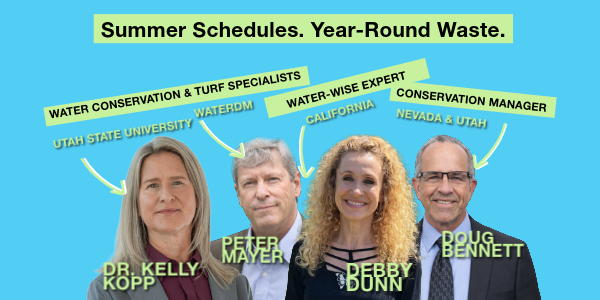
We spoke with water conservation experts to understand why scheduling waste persists and what conservation programs can do about it.
Debby Dunn, Waterwise Landscape Expert
Debby Dunn brings decades of experience in water conservation program design and implementation, specializing in waterwise landscaping and efficient irrigation. Her experience includes assisting and educating over 12,000 people over the decades including her positions as the Water Conservation Administrator of the City of Beverly Hills and the Senior Water Resource Specialist for the San Diego County Water Authority.
Dunn identifies the most impactful conservation action:
“One of the top ways residential customers can use water efficiently is by setting their controller properly.”
“Too many residents do not know how to use their controllers.”
Dunn’s takeaway: Most homeowners or their landscapers set their controllers once during installation and never adjust them (aka: the terrible “set it and forget it”). This causes systems to run at maximum output year-round, wasting water regardless of actual plant needs or weather conditions.
Doug Bennett, Conservation Manager
Doug Bennett is the conservation manager for Utah’s Washington County Water Conservancy District. He has more than 28 years of experience in water conservation at three western water agencies and is a nationally recognized leader with more than a dozen professional awards.
Bennett pinpoints two critical scheduling failures:
“The greatest percentage of water is wasted in the fall… people don’t change their schedules when demand drops.”
“If everybody turned off irrigation when it rained, we’d save over 40 million gallons per day.”
Bennett’s takeaway: Landscape water demand drops as temperatures cool, but schedules stay locked on summer settings. Systems continue watering during rainstorms because residents don’t override controllers. The technology works but human behavior just doesn’t adapt.
Dr. Kelly Kopp, Professor and Water Conservation Specialist
Dr. Kelly Kopp is a Professor and Extension Water Conservation Specialist at Utah State University and Director of USU’s Center for Water Efficient Landscaping. A nationally recognized expert in urban water conservation, she administers the Water Check Program, which has helped thousands of Utah residents reduce outdoor water use.
Kopp reframes where the real problem lies:
“Most outdoor waste comes down to poor maintenance and poor scheduling, not the plants themselves.”
Kopp’s takeaway: Irrigation management – not vegetation choice – drives water savings. A poor irrigation schedule wastes water regardless of what’s being irrigated. Fix irrigation scheduling, and you’ll see immediate savings.
Peter Mayer, Principal and Founder of WaterDM
Peter Mayer is Principal and Founder of WaterDM, a professional engineer and urban water expert whose work focuses on water demand research and efficiency planning. In 2025, he received the Water Star award from the Alliance for Water Efficiency and has worked with hundreds of water utilities across the US and Canada.
Mayer acknowledges the behavioral challenge:
“People respond well to weather, but there is still no easy behavior fix for irrigation scheduling.”
Mayer’s takeaway: Homeowners may skip watering when it rains, but sustained widespread behavior change like monthly adjustments and seasonal reductions will not happen without automation. Smart controllers remove the burden entirely.
Your Program’s Next Move
The technical solution exists: smart controllers that adjust automatically based on weather, soil moisture, or evapotranspiration. The challenge is getting residents to adopt them and—for those with conventional controllers—simplifying the adjustment process.
Research shows homeowners avoid conservation programs when they appear complex. Manual controller adjustments require technical knowledge that most residents don’t have. Even motivated homeowners struggle to maintain appropriate seasonal scheduling without automated systems.
Three immediate actions:
- Prioritize smart controllers that automate seasonal adjustments and weather response
- Create simple seasonal adjustment guides (one-page checklists with month-by-month settings)
- Make irrigation controller education visible through yard signs celebrating “Smart Scheduler” participants
For strategies that increase program participation, see our guide on 34 behavioral tactics for water conservation.