How Barrie, Ontario Cut Household Water Use by 30% in One Year
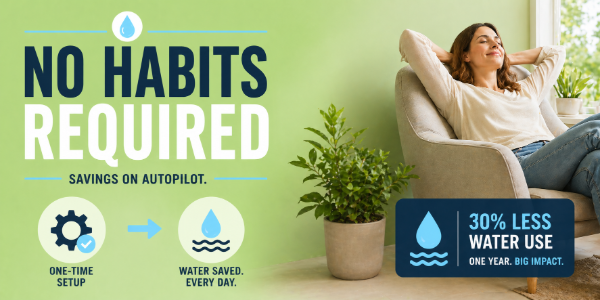
The water conservation campaign allowed them to postpone costly infrastructure upgrades for 7 years – and future-proofed the system for a growing population.
In the mid-1990s, Barrie, Ontario, faced a looming water supply problem.
Barrie’s Barrier-Busting Blueprint for Saving Water
- Technology made saving automatic: Ultra-low-flow toilets, showerheads, and aerators reduced water use by design, requiring no behavior change from homeowners.
- Cost reduction removed the price barrier: A $145 rebate per toilet made ULF models effectively free, eliminating the upfront expense that stopped most upgrades.
- Pre-qualified experts removed the hassle barrier: The city lined up vetted plumbing contractors at fixed installation prices, so homeowners didn’t have to find, vet, or negotiate with anyone.
- Awareness made the options visible and actionable: Newspaper ads, bill inserts, mall displays, and information kits kept the offer in front of residents with a clear next step to take.
Over a ten-year period, Barrie was looking at roughly $68 million in water and sewer capital spending, including a projected $27 million surface water supply project to meet the increasing demand.
But rather than expanding the infrastructure to meet rising demand, they sought a simpler solution: Lower the demand – enough to postpone an increase in wastewater treatment capacity and delay construction of a new water treatment plant.
And it worked. Barrie reduced water use by 30% in the first year alone and delayed major infrastructure improvements for 7 years.
Not by making water rates higher, or changing water use laws, or even asking people to change their habits.
They just removed the human behavior and automated with technology upgrades: upgrade water fixtures – toilets, faucets, showerheads, etc – to newer, more efficient ones.
How the Program Worked on the Ground
Barrie’s program combined a few practical moves with sound behavioral science. Here’s what the city did, and why each piece worked.
Focused on technology.
The city’s conservation program centered on fixture replacement. Toilets were the main target, but the program also covered showerheads and faucet aerators. This was one of the first programs of its size in Canada.
The intention–action gap, a theory based on a meta-analysis of intention-behavior relations by Sheeran & Webb, partially explains why this works. People intend to conserve but routinely fail to act on their intention. Using technology to automate behavior, like with fixture replacement, bypasses the gap entirely because no follow-through is required after install.
The city lowered the cost.
Barrie offered a $145 rebate per toilet, which made many ultra-low-flow models effectively free or close to free to the homeowner. Low-flow showerheads were also subsidized.
The zero-price effect, documented by Shampanier, Mazar & Ariely (2007) in Marketing Science, partially explains that demand doesn’t just rise as price drops, it spikes disproportionately when the price hits zero. Barrie’s rebate brought ULF toilets close enough to free that homeowners stopped weighing the trade-off and simply acted.
The city lowered the hassle, too.
The city set up pre-qualified plumbing contractors and offered installation at fixed prices. Residents who asked about the program received an information kit with the rules, the eligible devices, and contractor details.
Choice overload, a theory developed by Iyengar & Lepper (2000) and popularized by Barry Schwartz in The Paradox of Choice, partially explains why this works. When people face too many options, they often default to no decision at all. Narrowing the contractor pool to a pre-qualified shortlist eliminates the decision paralysis that would otherwise stop homeowners from following through.
The city paid attention to outreach and message placement.
Barrie promoted the program through newspaper ads, bill inserts, and permanent displays at shopping malls and home shows. Community groups helped spread the word. The goal was to keep the offer visible and easy to understand in places people routinely were.
Integrated Marketing Communications (IMC), a framework formalized by Don Schultz at Northwestern University in the early 1990s, holds that consistent messaging across multiple channels compounds impact, and Barrie hit homeowners with the same offer through ads, bill inserts, mall displays, and community groups, building familiarity in the places they already were.
They asked for a small commitment.
The program was simple, but asked homeowners to take the first step. That tends to increase follow-through. Residents saw the offer, contacted the city, received a kit, and then chose whether to use an approved contractor or do the work themselves.
Programs that require people to actively opt in produce stronger follow-through because choosing creates ownership of the decision. Barrie’s design required homeowners to reach out first, turning them from passive recipients into active participants. This is an example of “active choice,” studied by Keller, Harlam, Loewenstein & Volpp (2011).
What Changed as a Result of the Program
The results were substantial.
By February 1999, 11,500 households – more than one third of the city’s 1994 housing stock – had joined the program, and 14,200 ultra-low-flow toilets had been installed. Follow-up interviews found very high satisfaction with both the program and the toilets themselves.
Water use measured in participating homes dropped by an average of 62 liters per person per day. One major summary of the program reports that household water use fell from 900 to 630 liters per household per day, a 30 percent reduction.
Another EPA summary reports 55 liters per person per day in total system savings from the program and says the reduction in wastewater flows helped defer new hydraulic capacity until 2011.
- Household water use fell from 900 to 630 liters per household per day – a 30% reduction.
- The program reduced use by an average of 62 liters per person per day, exceeding Barrie’s target of 50 liters per person per day.
- Barrie reported estimated total savings of 1,782,500 liters per day.
- The city installed 14,200 ultra-low-flow toilets through the program.
- From early 1995 through February 1999, Barrie spent about $3.7 million and assisted 11,500 households, for an average total program cost of just under $323 per household.
- Barrie’s reported $3.1 million investment translated into a $18.7 million net capital deferral for seven years.
- The city also delayed a projected $27 million filtration plant project by seven years.
- One summary reports that by pairing conservation with a $20 million treatment plant upgrade, Barrie avoided $43 million in immediate infrastructure costs.
The numbers vary somewhat by source and year of reporting, but they all point in the same direction: the program cost real money, and it still cost much less than the infrastructure Barrie would otherwise have needed sooner.
How To Do the Same
Insightful conservation managers started by looking at where treated water was being wasted inside homes – and asking why people had not fixed it already.
Here’s how they saw the problem:
- Older inefficient toilets, faucets, showerheads, and aerators use significantly more water than newer ultra-low flow (ULF) certified fixtures. It’s not as if homeowners want to use more water with each flush or with every minute in the shower – it’s just how older fixtures were designed.
- Older fixtures increased barriers for motivated homeowners from being more efficient. Replacing them lowers water use automatically – it’s just how newer faucets work. No need to change water use habits, to ask for constant vigilance over every drop.
- Sounds like a no-brainer. That said, people have busy lives and don’t often give much thought to water use rates of various toilets and showerheads. Even if they do, it’s a hassle to replace them when the old ones still work.
Question: How do you get a homeowner to overcome their reluctance to replace a toilet when the old, inefficient one works fine?
 Want a framework for turning behavioral research into utility programs? Read how community-based social marketing helps conservation teams remove barriers and make water-saving behaviors easier to adopt.
Article: Community-Based Social Marketing: Increase Water Conservation with Limited Rebate Budgets
Community-Based Social Marketing (CBSM) makes changing behavior a straightforward and repeatable process.CBSM is an evidence-based approach to social marketing for environmental conservation. It meets people where they live, literally and psychologically – a good framework for designing conservation programs. CBSM focuses on three questions:
Then it designs programs that remove those barriers individually. The goal is to close the gap between what people intend to do and what they actually do. |
In Barrie’s case:
- The specific behavior with the most water-saving impact would be to replace inefficient water fixtures.
- Homeowners, of course, decide when and how to replace stuff in their homes.
- Two obvious barriers are stopping homeowners from upgrading on their own:
-
- the upfront cost of new fixtures
- the inconvenience or cost of installation
Many homeowners agree that efficient fixtures are a good idea. Far fewer will spend their own money, find a contractor, compare prices, and follow through. As the old saying goes, “If it ain’t broke …”
Whatever the reason for their reluctance, it’s a barrier – and a clear target.
Utilities designed a program to remove those barriers by making new water fixtures and their installations essentially free. Within three years, the program aimed to contact every household, complete fixture replacement in 15,000 of the city’s 26,000 households, and reduce water use in participating homes by 50 liters (about 13 gallons) per person per day.
The Numbers
| How much? | For what? |
| 30% | Reduction in household water use |
| 62 liters/person/day | Average reduction in water use in participating homes |
| 55 liters/person/day | Total system water savings from the program |
| 14,200 | Ultra-low-flow toilets installed |
| 11,500 households | Households participating by February 1999 |
| $145 | Rebate per toilet |
| $53 | Set installation fee for one toilet in the early program design |
| $3.7 million | Program spending through February 1999 |
| $17.1 million | Net savings after scaling down the upgrade cost and accounting for program cost |
| $19.2 million | Revised cost of upgrade after conservation effects were incorporated |
| Beyond 2020 | Delay of lake-based filtration plant construction |
Why This Matters for Policy and Efficiency
Barrie treated conservation as part of infrastructure planning. That is the most useful thing about this case. It compared the cost of a retrofitting campaign with what it would cost to build more capacity sooner.
Water conservation programs should be part of long-range water supply planning, and residential retrofit programs can substantially lower demand when participation is high.
Remember This
There are many simple ways to get more mileage out of the water you already have. It’s a smart first step to take when planning for population growth or drought, or any situation where your water system may be nearing capacity.
And sometimes, those water savings are within easier reach than you think. A smart program designed to make water-saving habits and choices more easy, obvious, or automatic will be more successful than rate hikes or informational brochures. And lowering average water consumption per capita will future-proof eventual system upgrades to be even more effective.
Sources
Canadian Municipal Water Conservation Initiatives
https://www.muniscope.ca/resource/dm/638367727150497296.pdf?n=file_Canadian_Municipal_Water.pdf&inline=yes
Cases in Water Conservation – U.S. EPA
https://www.epa.gov/sites/default/files/2017-03/documents/ws-cases-in-water-conservation.pdf
Barrie Water Conservation Program – Tools of Change Case Study
https://toolsofchange.com/en/case-studies/detail/103/
Barrie Water Conservation Program – CBSM database
https://cbsm.com/cases/34099-barrie-water-conservation-program
North American Municipal Water Efficiency Programs – City of Guelph Water Conservation and Efficiency Study, Appendix A
https://guelph.ca/wp-content/uploads/WCES-AppendixA.pdf
Showerhead Replacement Final Report – Southwest Florida Water Management District
https://www.swfwmd.state.fl.us/sites/default/files/medias/documents/Showerhead_Replacement_Final_Report.pdf