Why Technical Fixes Work Best with Behavioral Change
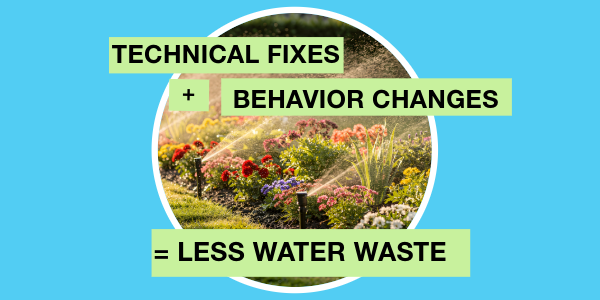
You can fix distribution uniformity, repair leaks, and install smart controllers. But if human behavior doesn’t change, water waste continues.
The uncomfortable truth: technology and infrastructure improvements only deliver savings when people use them correctly. Poor maintenance, resistance to change, and behavioral inertia undermine even the best-designed systems.
Key Takeaways:
- No silver bullet exists for outdoor water waste; it’s a complex behavioral issue
- Improved system efficiency doesn’t guarantee water savings without behavior change
- Education is expensive and doesn’t reliably change behavior
- Feedback and social comparison drive change more effectively than information alone
We spoke with water conservation experts and behavioral economists to understand why human behavior remains the hardest problem to solve.
Peter Mayer, Principal and Founder of WaterDM
Peter Mayer is Principal and Founder of WaterDM, a professional engineer and urban water expert whose work focuses on water demand research and efficiency planning. In 2025, he received the Water Star award from the Alliance for Water Efficiency and has worked with hundreds of water utilities across the US and Canada.
Mayer frames the fundamental challenge:
“There is no silver bullet for outdoor water waste. It’s a complex system.”
“People must decide to change, and that’s the hard part.”
Mayer’s takeaway: Conservation managers search for simple solutions: the one technology or program that solves everything. But outdoor water use involves plant choice, soil type, system design, maintenance, scheduling, and human behavior. All must work together. The hardest variable is getting people to decide to change their habits and maintain new practices over time.
Doug Bennett, Conservation Manager
Doug Bennett is the conservation manager for the Washington County Water Conservancy District. He has more than 30 years’ experience in water conservation at three western water agencies and is a nationally recognized leader with more than a dozen professional awards.
Bennett shares a sobering case study:
“We dramatically improved the performance of irrigation systems at 200 homes, but water use didn’t go down—the human factor appears to have killed the savings.”
Bennett’s takeaway: His team improved distribution uniformity at 200 homes, objectively improving system efficiency. Water use should have dropped. It didn’t.
Why?
He hypothesizes that homeowners didn’t take full advantage by adjusting their schedules. They kept watering the same amount despite needing less. Technical improvements mean nothing if behavior doesn’t adapt. This is why programs focusing solely on irrigation system upgrades without behavior support often underdeliver.
Dr. Marco Palma, Professor of Agricultural Economics
Dr. Marco Palma is a Professor of Agricultural Economics at Texas A&M University and Director of the Human Behavior Laboratory. His expertise lies in behavioral and experimental economics, with a focus on understanding how human decision-making and psychological factors influence behavior.
Palma offers the solution:
“People respond to feedback—comparison drives change.”
Palma’s takeaway: Behavioral research consistently shows that feedback and social comparison drives change. When residents see their water use compared to neighbors, or view neighborhood dashboards showing conservation participation, they feel pressure to conform. This is why norm nudges and public signals work.
Your Program’s Next Move
Human behavior is the bottleneck. Technical solutions fail without behavioral support. Education alone doesn’t work at scale. The solution? Design programs that account for how people actually behave, not how we wish they would.
Three Actions You Can Take Today:
- Make conservation visible: Use yard signs, dashboards, and public recognition to create social pressure
- Provide feedback loops: Show residents their water use compared to neighbors
- Simplify decision-making: Automate wherever possible to remove behavioral burden
For comprehensive behavioral strategies, see:
- 34 behavioral tactics that increase conservation participation
- How norm nudges drive long-term conservation
- What motivates people to change irrigation behaviors