
The Complexity Problem and the Education Gap: Water Waste Roundup
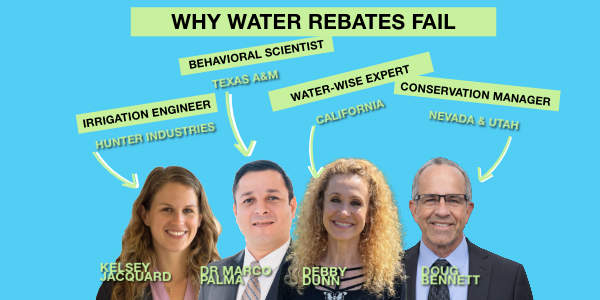
Water conservation programs invest heavily in rebates and technology. But when homeowners don’t understand their irrigation systems—and when the professionals installing them don’t either—those investments fail.
Homeowners struggle with controllers. The technical complexity exceeds most homeowners’ capacity to learn and maintain efficient practices.
Key Takeaways:
- Many landscapers lack irrigation knowledge, creating cascading misinformation
- Plants don’t waste water: people do
- Homeowners want simple answers, but irrigation management is inherently complex
- Social comparison drives adoption more effectively than education alone
We spoke with experts to understand why the education barrier is so difficult, and what actually works.
Debby Dunn, Waterwise Landscape Expert
Debby Dunn brings decades of experience in water conservation program design and implementation, specializing in waterwise landscaping and efficient irrigation. Her experience includes assisting and educating over 12,000 people over the past few decades including her positions as the Water Conservation Administrator of the City of Beverly Hills and the Senior Water Resource Specialist for the San Diego County Water Authority.
Dunn identifies the root of the education problem:
“The formula for landscapes has changed over the decades. The challenge is to now teach the landscape maintenance community how to install and maintain efficient irrigation. To exacerbate the issue, homeowners and property managers take advice from landscapers who often need expert training.”
Dunn’s takeaway: The education gap runs through the entire irrigation process. Many landscapers know enough about plant selection but lack formal training in irrigation design, installation, or controller programming. Homeowners inherit systems they don’t understand from maintenance staff who often weren’t experts in them.
Doug Bennett, Conservation Manager
Doug Bennett is the conservation manager for the Washington County Water Conservancy District. He has more than 28 years of experience in water conservation at three western water agencies and is a nationally recognized leader with more than a dozen professional awards.
Bennett sees the gap between what homeowners want and what they actually need:
“People just want it simple—’tell me which days to water.'”
“Controllers, maintenance, and DU are too complex for most customers without visual or hands-on teaching.”
Bennett’s takeaway: Homeowners want one-sentence answers. But effective irrigation requires understanding controllers, seasonal adjustments, and system maintenance. Without visual teaching or direct technical assistance, most homeowners won’t implement—or maintain—efficient practices.
Kelsey Jacquard, Senior Category Manager, Hunter Industries
Kelsey Jacquard is the Senior Category Manager for Mechanical Landscape Irrigation Products at Hunter Industries. She works closely with the Product Management team on sprinklers, valves, and micro irrigation systems, and serves on the Irrigation Association’s Landscape Advocacy Committee.
Jacquard questions whether decision-makers fully understand what is available and how to use it to maximize irrigation efficiency. Much of water efficiency comes from using products correctly and maintaining the system.
“A lot of it is the training: Knowing what technology is available and how to use it.”
Jacquard’s takeaway: Technology exists to solve irrigation waste problems like pressure regulation, efficient nozzles, and smart controllers. But availability doesn’t equal adoption. The barrier is educating homeowners and professionals on new tools, technologies, and irrigation best practices. Even when the technology works, people need to know it exists and how to use it properly.
Dr. Marco Palma, Professor of Agricultural Economics
Dr. Marco Palma is a Professor of Agricultural Economics at Texas A&M University and Director of the Human Behavior Laboratory. His expertise lies in behavioral and experimental economics, with a focus on understanding how human decision-making and psychological factors influence behavior.
Palma shifts focus from education to behavioral change:
“People need to see how they compare to others—public signals create interest, open-conversation and adoption.”
Palma’s takeaway: Education alone rarely changes behavior at scale. Social comparison and public signals drive adoption in other similar domains more effectively than information campaigns alone. When homeowners see neighbors’ water use or yard signs celebrating conservation, they feel social urgency to participate in the water conservation movement and create momentum for behavioral adoption. This complements the education barrier entirely and can boost its effectiveness.
Your Program’s Next Move
The education challenge is real: irrigation management is genuinely complex, the workforce installing systems often lacks training, and utilities can’t personally teach every household.
The solution isn’t more pamphlets. It’s making conservation simpler to adopt and more socially visible.
Three immediate actions:
- Simplify through automation: Prioritize smart controller rebates that eliminate the need for technical knowledge
- Make conservation visible: Use yard signs, dashboards, and neighborhood competitions to create social urgency.
- Create hands-on learning: Offer in-person irrigation audits and system checks that teach while improving systems
For comprehensive strategies on behavioral approaches that work better than education alone, see: