
Utah Advances Water Conservation Legislation That Reframes the Role of Turf
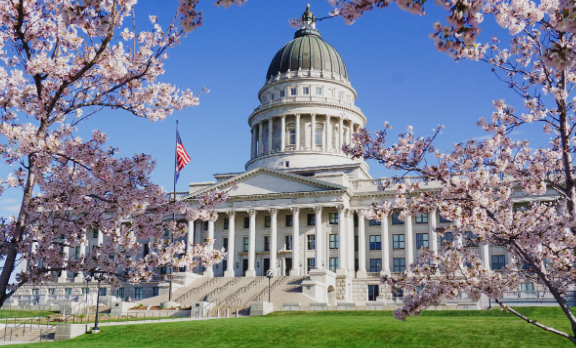
The Utah Legislative Water Development Commission unanimously approved the Water Wise Landscaping Amendments on November 20, 2025. The bill, sponsored by Senator Keven Stratton, promotes appropriate grass species paired with smart irrigation technology rather than restricting turf.
What the Legislation Does
The Water Wise Landscaping Amendments apply specifically to state-owned properties and establish three primary requirements:
Canopy Coverage – State facilities built or reconstructed after May 6, 2026 must ensure that canopy—the coverage provided by trees and tall shrubs—covers at least 50% of landscaped grounds.
Functional Turf Definition – The legislation creates a classification for turf that qualifies as “functional.”
This includes grasses used for active recreation like sports fields and parks. It also includes other turf if it meets specific criteria: the grass must be native, adapted to dry conditions, or officially designated as low-water-use by Utah State University Extension.
Smart Irrigation Requirements – For turf not used for active recreation, the bill requires efficient watering practices.
Properties must either avoid overhead spray irrigation (sprinklers that spray water through above-ground nozzles) or use weather and soil-based monitoring technology that adjusts watering to match what the grass actually needs.
State properties can maintain turf under this framework, provided it’s an appropriate grass species managed with efficient irrigation practices.
The Functional Turf Framework
The legislation defines functional turf through two categories:
Active Use Turf – Turf dedicated to active community purposes automatically qualifies as functional. This includes sports fields, parks, social gathering areas, amphitheaters, golf courses, and cemeteries.
Environmentally Appropriate Turf – Turf that is not used for active recreation can still qualify as functional if it meets all four criteria:
- Installed or maintained on areas with slopes of 25% or less
- At least eight feet wide at the turf’s narrowest point
- Native plant, hybridized for arid conditions, or designated as low-water-use by Utah State University Extension
- Watered to match the plant’s needs and does not require overhead spray irrigation unless paired with activated weather or soil-based monitoring technology
Turf that does not meet either definition is limited to 20% of a facility’s grounds (or less if local ordinances impose stricter limits) and cannot be installed in park strips (the area between curbs and sidewalks).
Why This Approach Matters
The coalition initially attempted broader language in spring 2025 that included turf providing “environmental benefits.” Water managers considered this definition too broad. The revised approach narrows the focus to specific grass species selection and irrigation technology.
The underlying principle is that the issue is not turf itself, but inappropriate grass species combined with inefficient irrigation practices.
By defining what qualifies as functional rather than what should be restricted, the legislation creates a pathway for maintaining healthy green spaces while achieving water conservation objectives.
Andrew Bray, testifying on behalf of NALP, emphasized that the legislation aims to stop treating all non-functional turf as problematic and instead promotes the concept that “green is good” when properly managed.
Additional Water Conservation Requirements
The legislation maintains and strengthens existing water conservation requirements for state agencies, including:
- 25% reduction in outdoor water use by fiscal year 2026 (compared to 2020 baseline)
- Restrictions on overhead spray irrigation between 10 a.m. and 6 p.m.
- Mandatory leak detection and repair programs
- Annual evaluations of opportunities to upgrade irrigation technology
- Coordination with the Division of Water Resources on efficient irrigation methods and practices
State agencies must also manually shut off irrigation systems during rain and wind events if those systems do not have activated weather or soil-based monitoring technology.
Weather-based irrigation controllers use local weather and landscape conditions to adjust watering schedules, while soil moisture-based controllers monitor moisture levels to prevent irrigation when water is not needed.
Looking Ahead
The legislation takes effect May 6, 2026. The coalition views this framework as a potential model for other states, emphasizing species selection and irrigation technology rather than turf restrictions.
The unanimous committee vote suggests this approach has broader appeal than frameworks that treat water conservation and landscape health as competing objectives.
The Water Wise Landscaping Amendments will be considered during Utah’s 2026 General Session. The bill is sponsored by Senator Keven J. Stratton.