Mild Peer Pressure Nudged Cobb County, Georgia Residents toward Long-lasting Water Efficiency
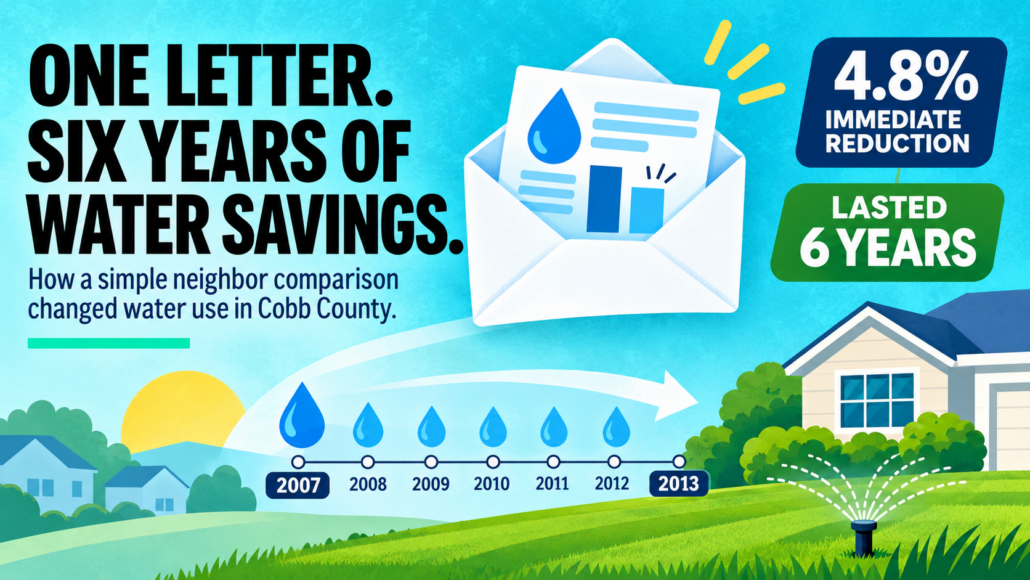
A letter comparing each household’s water use to the county median was more effective than other messaging, resulting in an immediate 4.8% average reduction in water use and behavioral change lasting at least six years.
During a severe drought in 2007, the Cobb County Water System (CCWS) in metropolitan Atlanta was looking for a more effective way to reduce water use — especially irrigation, which was the biggest component of water consumption during summer months by far.
Key Takeaways: Using Social Pressure to Change Habits
- Social comparison is a strong motivator. Telling people how they compared to the county median water use prompted an immediate 4.8% average reduction per household, totalling 1,740 gallons for the June-September study period.
- Peer comparisons are better than tips. Comparison between neighbors drove change better than a plea for community help or tip sheet on saving water.
- Comparison reaches high-use households. The campaign was most effective for the wealthier, high-use, owner-occupied households that are least motivated by financial incentives like rate hikes.
- A single message can have lasting effects. A six-year followup found that participants were still making some effort to save water.
Want a framework for turning behavioral research into utility programs?Read how community-based social marketing helps conservation teams remove barriers and make water-saving behaviors easier to adopt. Article: Community-Based Social Marketing: Increase Water Conservation with Limited Rebate Budgets |
Background
Since 1998, Cobb County’s water supply had been struggling with periodic drought and disputed access rights to surface water supplies. In 2007, the conditions were classified as “extreme drought.” The county was consuming 10% of the entire state’s water supply, and irrigation accounted for the majority of residential water use during the summer months.
Cobb County introduced tiered pricing in January 2006, but the biggest water users tended to be higher-income homeowners who are less sensitive to price increases (price-inelastic). So Cobb County turned to social currency: showing residents how much water they were using compared to the median household.
How the Program Worked on the Ground
Cobb County partnered with researchers from Georgia State University and the University of Tennessee in 2007 on an experiment that ran from June through September. It tested the effect of non-monetary “behavioral nudge” concepts made popular in the bestselling 2008 book Nudge: Improving Decisions About Health, Wealth, and Happiness. In the book, authors describe motivating certain behaviors by changing how options are presented, rather than with punitive mandates or financial penalties.
Over 100,000 CCWS households were divided into a control and three other groups, with each of the latter receiving a mailer with one of three messages:
- Group 1: control, no mailer
- Group 2: a standard tip sheet on how to save water
- Group 3: a tip sheet with an additional message explaining the drought conditions and encouraging households to follow the tips
- Group 4: a tip sheet, the additional message, and a comparison of the household’s water use from the previous summer against the county median
Researchers recorded a 4.8% drop in average irrigation water use in Group 4 in 2007, which continued with some diminished savings until at least the end of the study period in 2013.
Utilizing Norms as Motivators
Group 2 (tips alone) achieved essentially no savings (this figure was not considered statistically significant.). Group 3 (tips combined with a conservation message) achieved a modest average household water savings of 2.7%, which disappeared by the end of the follow-up study period.
The researchers attribute this effectiveness to Leon Festinger’s 1954 “social comparison theory” — people evaluate their actions in comparison to others’ actions. MINDSPACE: Influencing Behaviour Through Public Policy, a 2010 UK government handbook, refers to this as pulling the “norms lever.” The detailed comparison also pulls the “saliency” lever by providing the target households with clear data on their high water use.
Social Comparison Theory Example
|
Excerpt from one of the comparison letters.
A similarly successful study in East Bay, California told homeowners how their consumption compared to that of properties of roughly the same size. The Cobb County study compared each household’s water use to the median of all properties, regardless of size. The researchers believe that this comparison was so effective because it was especially unflattering for the biggest properties and water users.
Scrutiny and Moral Cost
As was the case in East Bay, Cobb County did not combine this messaging with monthly bills. Instead, both areas sent a separate, personalized letter related to water use and comparisons. Calling out excessive water use explicitly in a special message, rather than burying it in a routine bill, increased the sense of scrutiny. The unfavorable comparison, combined with the knowledge that someone was paying close attention, heightened the perception of “moral cost” for violating social norms.
Focusing on Behavioral Change
While providing free or subsidized water-saving technologies such as smart irrigation controllers or low-flow shower heads can produce meaningful reductions in water use, research suggests that lasting conservation depends on homeowner engagement. When customers understand, value, and adopt water-efficient behaviors, the benefits extend well beyond the installation of new technology
A six-year follow-up study found that sustained water savings were driven primarily by long-term behavioral change. Although savings gradually declined from 4.8% in 2007 to 0.9% by 2013, a single conservation letter was still influencing water use six years later. The effect disappeared only when the original residents moved away and were replaced by new occupants. The findings suggest that lasting conservation is driven less by technology alone than it is by cultivating a conservation mindset.
What Changed as a Result
- Households that received the additional comparison achieved an immediate 4.8% reduction (compared to 2.7% for those who received the explanatory letter with tips and effectively no reduction at all for those who received only tips).
- The county estimated that a price hike of 12% to 15% would have been required to motivate similar change.
- Savings came from changing outdoor summer watering habits and did not impact winter consumption.
- Because the water-conserving habits stuck, the county recalculated the cost of the intervention from $0.58 to just $0.24 per 1,000 gallons saved.