What Will It Take to Be Ready for the Next Drought? Drought Readiness Report
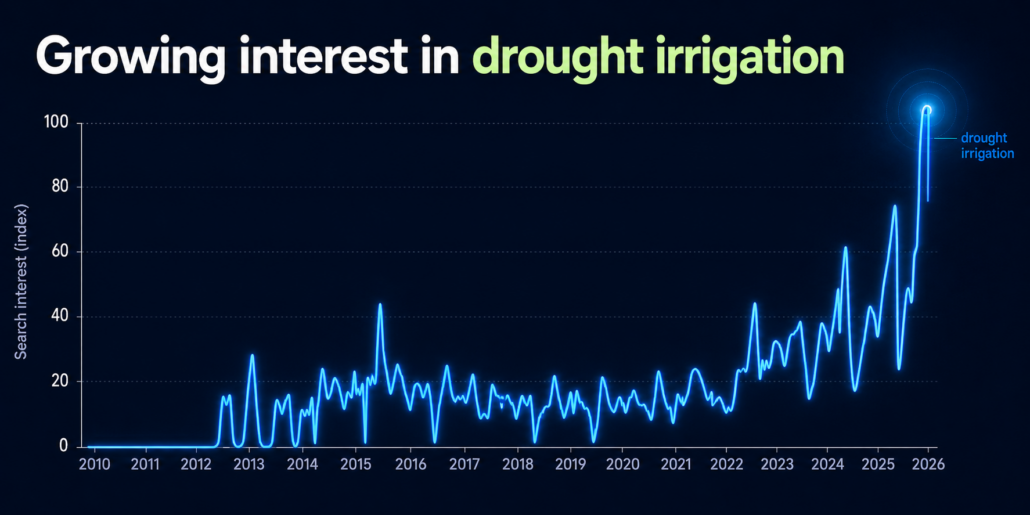
The United States is entering one of the most water‑stressed periods in recent memory. In fact, according to a report in the journal Nature by UCLA researchers, the western United States is seeing the longest and harshest drought for the last 1,200 years. Warning signs are everywhere. In a new report by Healthy Green Spaces, multiple independent data streams point to the same conclusion: drought risk is rising, water demand is intensifying, and people are looking for answers.
Key Takeaways
- As of April 2026, more than half of the continental U.S. is experiencing drought conditions.
- U.S. Google searches for “drought irrigation” and “smart irrigation” both hit their highest-ever index value of 100 in early 2026.
- Research shows that when programmed accurately smart irrigation controllers can reduce outdoor water use by about 20–50%.
Urban and suburban landscapes, like parks, trees, turf, and other green infrastructure, are not just aesthetic features. They provide essential ecosystem services, including urban cooling, stormwater management, air quality improvement, and measurable mental and physical health benefits. Yet drought places these benefits at risk. When water supplies tighten, communities are often forced into reactive conservation measures that degrade or eliminate green space. The result is a tradeoff between reducing water use and maintaining the landscapes that support livability.
Google Trends data show searches for “drought irrigation” hitting an all-time high in early 2026. NOAA’s Spring Outlook warns of expanding drought conditions across the West and Plains, and HGSC’s own research has documented how a deceptively wet winter has drained the snowpack that communities rely on for summer water supply.
The good news is that there is a concrete, practical response available right now. Smart irrigation is emerging as one of the most effective, fastest‑payback tools for homeowners, utilities, and landscape managers to reduce outdoor water consumption while sustaining the landscapes that depend on it. Search interest in smart irrigation has climbed from near zero in 2004 to an all‑time peak in April 2026, and multiple studies show these systems can reduce outdoor water inefficiency by roughly 20–50% when paired with basic maintenance.
The Drought Signals Are Unmistakable
The most direct signal of public alarm is search behavior. Americans turn to Google when they sense a problem, and the data are unambiguous. Monthly Google Trends data for the U.S. show that searches combining “drought” and “irrigation” reached their highest recorded level in March 2026, at an index score of 100, more than doubling from a score of 41 just twelve months earlier in March 2025, on Google’s 0–100 scale where 100 represents that term’s own peak month.
This is not an isolated spike. The trend has been climbing steeply since 2022, when drought concerns began rising from annual averages in the mid-20s on the 0–100 index to sustained readings above 40–50 by 2024–2025. The signal is particularly significant because it covers the full year, not just summer peak season, reflecting a year-round anxiety about water stress that did not exist at this scale a decade ago.
Searches for “irrigation” followed the same trajectory, reaching an all-time peak index of 100 in April 2026, compared to typical spring readings of 50–70 in prior years. Americans are not just curious about drought in the abstract — they are actively looking for solutions.
Drought Is Expanding
The scientific record validates what search behavior is signaling. The National Oceanic and Atmospheric Administration (NOAA) released its Spring 2026 Outlook with a stark warning: drought conditions are forecast to worsen or develop across large portions of the U.S., particularly across the Pacific Northwest, Great Basin, central Rockies, and Southwest. As of mid-March 2026, moderate to exceptional drought already covered 55% of the continental United States.
HGSC’s own research uncovered a data-driven explanation for why many Western states face higher drought risk than their rainfall totals would suggest. The Warm Rain Paradox describes how near-normal winter precipitation can still leave watersheds drought-prone when temperatures cause precipitation to fall as rain rather than building snowpack.
As Jon Meyer, Ph.D., Assistant State Climatologist at the Utah Climate Center, explained: “Getting a gallon of rainfall in January is certainly not the same as a gallon of snow water that’s kept through April or May.” The consequence is predictable: reservoirs fill fast in winter, managers release water for flood control, and by summer there is nothing left to refill them.
The Public Is Searching for Solutions
The same Google Trends data that documents rising drought anxiety shows a parallel surge in solution-seeking. Searches for “smart irrigation” climbed from near zero in 2004 to a record index of 100 in April 2026, up from a monthly average of roughly 14 as recently as 2024.
Searches for “smart controller” followed an almost identical path, reaching an all-time index of 100 in April 2026 compared with single-digit readings through most of 2010–2018. Searches for “best irrigation controller” showed the most dramatic recent spike: essentially zero from 2004–2012, climbing gradually to the mid-30s range by 2020–2023, and then surging to an all-time peak of 100 in March 2026. This surge in commercial-intent searches, consumers actively trying to buy the best controller, is a strong signal that the market has reached an inflection point.
What Smart Irrigation Actually Delivers
The starting point for understanding smart irrigation’s value is recognizing how much water can be reduced without sacrificing landscape performance. According to studies cited in HGSC’s Irrigation Waste Report, 30–60% of irrigation water is wasted due to leaks, misaligned heads, and poor scheduling.
The EPA estimates that as much as 50% of all residential outdoor water is wasted due to overwatering from inefficient irrigation methods and systems. For water managers responding to drought conditions, irrigation represents one of the most immediate and controllable opportunities to reduce consumption.
Simple maintenance, which costs little and requires no specialized skills, can reduce outdoor water consumption by 20–30% without changing plants or redesigning landscapes. Beyond maintenance,smart irrigation technologies provide a scalable and measurable pathway to sustained reductions in outdoor water use.
- Replacing a standard clock-based controller with a WaterSense-labeled smart controller saves an average home up to 15,000 gallons of water annually, according to EPA WaterSense.
- EPA’s WaterSense program estimates that if every U.S. home with an automatic sprinkler system installed and properly operated a WaterSense-labeled controller, it could save up to 390 billion gallons of water and about $4.5 billion in water costs per year
- Weather-based (ET) smart controllers save an average of 20–30% compared to timer-based systems
- Soil moisture sensor systems can achieve up to 66% savings in some conditions
Dr. Kelly Kopp, Professor of Plants, Soils & Climate and Director of the Center for Water Efficient Landscaping at Utah State University, summarized the evidence plainly: “When you really dig into the numbers, irrigation upgrades — scheduling, system design, and maintenance — are the most consistent source of lasting water savings.” She adds: “Irrigation technology and management are more important than vegetation type with regard to water conservation.”
Irrigation’s outsized role extends to baseline demand: it already accounts for more than 65% of residential water consumption in water-stressed regions. This makes irrigation the highest-leverage intervention available for reducing outdoor water use. For utilities and water managers, smart irrigation is a practical, near-term tool for reducing water consumption during drought while maintaining the green infrastructure communities rely on.
The Case for Acting Now
All three signals, drought conditions, search behavior, and a surge in consumer interest in smart irrigation solutions, are converging at the same moment. NOAA’s drought expansion forecast covers the spring and summer of 2026. Google Trends data show consumer interest in smart irrigation and controllers at all-time peaks in April 2026. And yet the overwhelming majority of residential irrigation systems remain on fixed-timer schedules that ignore seasonal variation, weather, and soil moisture.
The practical implication: utilities, municipalities, and landscape professionals have a rare alignment of public concern and market demand that creates an unusually receptive moment for smart irrigation adoption. Communities that move first, by deploying rebate programs, education campaigns, or policy requirements, can lock in water savings before drought conditions force emergency restrictions.
Utah provides a legislative model worth watching. Recent state legislation advanced requirements for smart irrigation practices on turf not used for active recreation, mandating efficient watering or the elimination of overhead irrigation — the same interventions that drove the largest documented water savings in turf replacement programs nationally.
This positions smart irrigation as a rare dual-benefit solution: one that allows communities to reduce water consumption quickly while avoiding the long-term costs of degraded or lost green infrastructure. The question is no longer whether to adopt smart irrigation. It is whether communities will act before the drought forces their hand.
Methodology
This report uses monthly U.S. Google Trends data (Jan 2004–Apr 2026) for five terms: “smart irrigation,” “smart controller,” “best irrigation controller,” “drought irrigation,” and “irrigation.” The data were exported with “All categories” and “United States” selected, using Google’s default 0–100 index where 100 is each term’s own peak month.
Each dataset was cleaned and merged by month so all five series line up on the same 268-month timeline. No smoothing, re-scaling, or interpolation was applied; zero values were kept as valid “near‑zero interest” months. Because Google normalizes each term separately, the analysis interprets the data as trend and timing signals (e.g., whether a term is at an all‑time high and when that occurs), not as absolute comparisons between search terms.
The narrative combines these updated trend lines with quantitative findings from existing Healthy Green Spaces Coalition studies on drought resilience, irrigation waste, turf rebate performance, and behavior change, and then cross-checks them against external sources such as NOAA’s Seasonal Drought Outlook and EPA WaterSense to validate drought risk and smart irrigation savings.