51 Water Facts to Transform Residential Water Use
In this article, The Healthy Green Spaces Coalition explores 51 of the most compelling current water facts. This statistical collection showcases how informed landscaping choices and efficient water practices enable communities to conserve resources, protect the environment, and cultivate thriving outdoor spaces for everyone.
How Much Water Does the Average Household Use?
Understanding household water use is essential to grasp the scale of water consumption and identify where conservation efforts can have the biggest impact.
Nationally:
- Each American uses an average of 82 gallons of water a day at home.
- The average American family uses more than 300 gallons of water per day at home.
- Nationally, roughly 70% of residential water use occurs indoors.
- The average family spends more than $1,000 per year on water costs.
- Installing water efficient fixtures and appliances uses 20% less water
- The average family can save more than $380 annually by retrofitting with WaterSense labeled fixtures and ENERGY STAR certified appliances.
How Much Water Is Used Outdoors for Landscaping?
Outdoor water use represents a significant portion of household consumption, particularly in arid regions, and offers key opportunities for conservation.
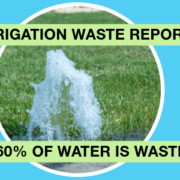
Indeed, Dr. Kelly Kopp, a plant scientist at Utah State University, shows in The Valve, The Healthy Green Spaces Coalition’s expert‑led publication, that 30–60% of irrigation water is wasted due to leaks, broken heads, and poor scheduling.
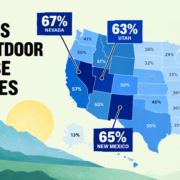
- Nationally, outdoor water makes up more than 30% of total household water use – but in states like Utah and Arizona residential outdoor water use is > 65 and 75%, respectively.
- Nearly 9 billion gallons of water daily in the U.S. is used outdoors.
- About 40% of the water Californians use at home is for outdoor purposes.
How Does Outdoor Water Use Vary by Region?
Climate, soil type, landscape design (plant location and material), and irrigation system age create massive regional variance.
- In the arid, West outdoor use can reach 60–75% or more of residential consumption.
- In Phoenix, between 60 and 70% of home water use is outdoor water use, primarily landscape irrigation.
- Utah’s Division of Water Resources reports that approximately 65% of the state’s residential water is used outdoors.
- Along Colorado’s Front Range, outdoor water use accounts for nearly 55% of residential water use, the majority used on lawns.
- Studies in humid-climate Florida counties show some irrigation-heavy households using 60–70% of their water outdoors, rivaling Western averages.
- The average Nevada resident uses 134 gallons per day, compared to 76 gallons per day in Indiana and 65 gallons per day in Iowa.
How Much Water Is Wasted Through Inefficient Irrigation?
Inefficient irrigation practices contribute to significant water waste, making efficient management essential. According to The Valve’s expert irrigation analysis, simple maintenance can cut outdoor water use by 20–30% without changing plants or redesigning landscapes
- Up to 50% of outdoor water-loss is due to sunken heads, broken pipes, tilted heads, poor pressure, wind, evaporation, and overspray from inefficient irrigation.
- Even a well-maintained irrigation system can waste as much as 25,000 gallons of water annually with just one broken sprinkler head.
How Much Water Is Lost Due to Household Leaks?
Leaks in household plumbing waste an enormous amount of water annually.
- Household leaks waste nearly 1 trillion gallons of water annually nationwide.
- This loss equates to the annual water use of 11 million homes.
- The average household wastes nearly 10,000 gallons annually from leaks.
- The average family loses about 180 gallons per week, or 9,400 gallons per year, to leaks.
- 10% of homes have leaks wasting 90 gallons or more per day.
- Fixing leaks can save about 10% on water bills.
- A faucet dripping one drip per second wastes more than 3,000 gallons per year.
- Leaky toilets can waste up to 200 gallons daily. Most toilet leaks are smaller, but still significant, as a worn flapper can quietly leak 30–50 gallons/day.
What Savings Come From WaterSense Fixtures and Appliances?
Water-efficient products labeled by WaterSense help families substantially reduce water use and costs.
- WaterSense products are at least 20% more water-efficient than standard models.
- Replacing toilets with WaterSense models saves the average family 13,000 gallons annually.
- WaterSense faucets can save $250 in water costs over their lifetime.
- WaterSense showerheads save over 2,700 gallons per year.
- A WaterSense irrigation controller can save up to 15,000 gallons annually, average savings are closer to 7,600 gallons.
- WaterSense labeled new homes reduce water use by at least 30%.
How Effective Are Smart Irrigation Controllers?
Smart controllers significantly reduce outdoor water use, especially among excessive irrigators.
- Only 10% of residential irrigation systems in the U.S. currently use smart controllers.
- Smart irrigation controllers reduce residential outdoor water use by 15% on average.
- Among higher water users, savings can exceed 40%.
- Well-programmed smart controllers paired with irrigation audits save the most.
- Replacing timer-based controllers can reduce water use by up to 30%.
- Smart irrigation can reduce commercial property water use by up to 50%.
What is the Overall Impact of the WaterSense Program?
The WaterSense program has helped conserve trillions of gallons of water and significantly reduce greenhouse gases.
- Since 2006, WaterSense has saved 8.7 trillion gallons of water.
- The program saved 1.2 trillion gallons in recent reporting periods.
- WaterSense has cut greenhouse gas emissions by 242 metric tons.
- The program’s energy savings equate to powering over 7 million homes annually.
What Are Western States Doing to Conserve Water at Home?
California and other Western states lead with aggressive regulations and incentive programs to cut residential water use, especially the heavy outdoor demand driven by irrigation.
- Landscape irrigation accounts for about 50% of residential water use statewide.
- Outdoor water use ranges from 30% in coastal communities to 60%+ in inland communities.
- Urban water use in California is at 1990 levels despite population growth.
- Across Southern California, per person potable water use has dropped from about 209 to 114 gallons per day since 1990. This represents a 45% decline supported by nearly $1 billion in conservation rebates and efficiency investments.
- Denver’s per capita water use dropped 20–40% from 2000 to 2020, with similar reductions in Salt Lake City (30%), and greater Las Vegas (47%).
- In Albuquerque, long‑running conservation efforts have reduced per capita water use by around 50% since the mid‑1990s, and the utility is now aiming for just 110 gallons per person per day by 2037, with an emphasis on outdoor efficiency and non‑potable supplies for public landscapes.
How Much Water Can Landscaping Choices Save?
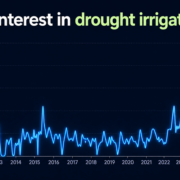
Using drought-tolerant landscaping and greywater reuse reduces landscape water use significantly. A Healthy Green Spaces search interest analysis shows that while ‘xeriscaping’ search interest has dropped by roughly 16 points since 2004, interest in smart irrigation has climbed by more than 20 points, and native plant landscaping has risen from 0 to 32 on the 0–100 index between 2004–2008 and 2020–2025.
- Xeriscaping reduces outdoor water use by 50-75%.
- Water-wise landscaping reduces water use by 35-70%.
- Greywater reuse can cut home water use by up to 40%.
- Greywater systems save households an average of 14,565 gallons annually.
Sources
EPA WaterSense Program, 2024-2025
U.S. Geological Survey (USGS), 2015-2023
California Department of Water Resources, 2023-2024
Peer-reviewed irrigation research, 2023-2024
Metropolitan Water District of Southern California, 2022-2025
Southern Nevada Water Authority and Las Vegas Valley Water District, conservation initiatives and turf rebate documentation, 2002–2025
Utah Division of Water Resources and Utah Foundation residential water use studies, 2010–2023
Penn State Extension and Virginia Tech Extension household water conservation guides, 2000–2025
University of Florida IFAS Extension and Western U.S. outdoor water use case studies, 2018–2025
Utility and academic water conservation reports, 2020-2025
Albuquerque Bernalillo County Water Utility Authority
Links:
- https://psc.wi.gov/documents/water/wc-ReportTemplate.docx
- https://savetexaswater.org/meeting/workgroup/doc/WCPTutorial_2017-1.pdf
- https://dot.ca.gov/-/media/dot-media/programs/environmental-analysis/documents/ser/sw-wqar-template-a11y.docx
- https://www.twdb.texas.gov/conservation/doc/SB181Guidance.pdf
- https://fo.media.uconn.edu/wp-content/uploads/sites/2782/2020/08/Water-Conservation-Plan.pdf
- https://www.nidwater.com/files/020241d52/AWWAMetricsGuidanceReport2010.pdf
- https://nyruralwater.org/downloads/downloads-other-materials
- https://www.waterplan.com/blog/water-reporting-for-corporate-sustainability-managers-the-basics
- https://www.lvvwd.com/conservation/measures/index.html
- https://www.snwa.com/water-resources/conservation-initiatives/index.html
- https://thenevadaindependent.com/article/with-new-law-las-vegas-water-agency-bets-on-aggressive-municipal-water-conservation-measures
- https://www.usbr.gov/watersmart/weeg/docs/2022/Southern_Nevada_Water_Authority_FGII_FY22WEEG_508.pdf
- https://content.csbs.utah.edu/~lozada/Research/DNR_WaterUse_original.pdf
- https://www.utahfoundation.org/reports/background-water-utah/
- https://extension.psu.edu/household-water-conservation/
- https://www.wellwater.bse.vt.edu/files/household%20water%20conservation.pdf
- https://edis.ifas.ufl.edu/publication/AE585
- https://www.abcwua.org/wp-content/uploads/Conservation_Rebates/2037_Water_Conservation_Plan.pdf